
How to build role-plays that challenge reps without breaking realism
Before you startThis guideline explains the fundamentals of how a PitchMonster role-play works - difficulty, traits, conversation steps, and objections - so anyone building scenarios understands what each control actually does.
1. Difficulty level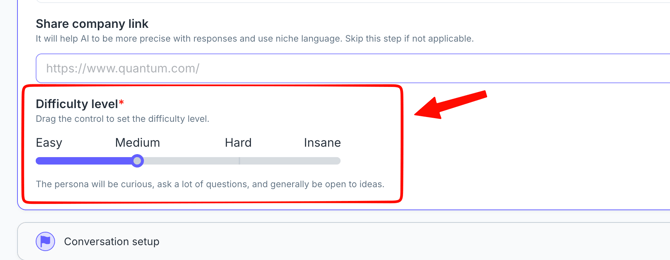
Set Medium as the default. It gives a real challenge while keeping the buyer broadly friendly - the right starting point for most calls.
|
Level |
What it brings to the role-play |
|---|---|
|
Easy |
Persona is much easier to persuade. Gives fewer objections and is less picky about the rep’s answers. |
|
Medium (default) |
A genuine challenge with an overall friendly buyer. Recommended starting point for most calls. |
|
Hard |
Persona applies extra pressure. Good for stress-testing reps against difficult buyers - passive-aggressive responses, bad moods, awkward behaviour. |
|
Insane |
Built to apply a lot of pressure. Best for cold calls and buyers meant to bring absolute madness to the conversation. |
Important to mention: with Hard and Insane, the AI also becomes pickier about how the rep responds to objections and conversation steps.
2. Traits (the context section)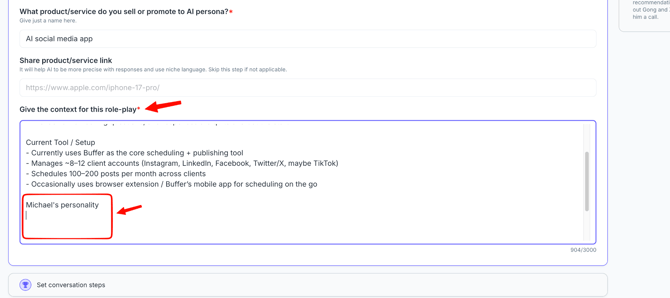
Personality is managed in the context section - a piece that is easy to leave out. Here you write down how the persona should behave. For example:
- Sassy
- Skeptical
- Data-driven
These traits feed directly into how hard the role-play feels, layering on top of the difficulty level. Describing the persona deliberately is one of the most effective ways to shape the challenge - do not skip it.
3. Conversation steps
Conversation steps explain the structure of the call so the AI knows how it should flow - where the rep introduces themselves, where they ask discovery questions, and crucially where the endgame is, so the AI knows when it can either reject or agree to the next step.
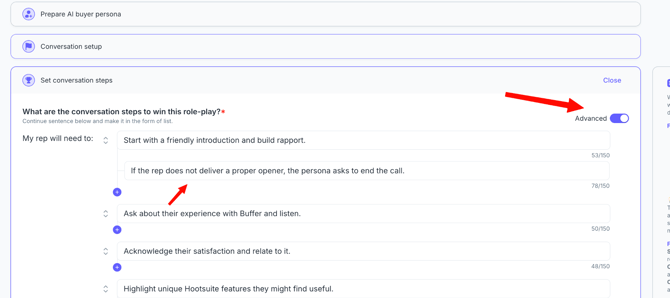
There is an advanced mode in the conversation steps. The main idea: you do not need it, unless you specifically want to build unexpected turns into the conversation. Those dependencies are good for cold calls. Examples:
- If the rep does not deliver a proper opener, the persona asks to end the call.
- If the rep skips questions, the AI becomes less talkative later in the call.
- If the rep asks too many questions, the AI tries to accelerate - pushing to jump to the value.
If you do not want dependencies like these, turn advanced mode off and keep the overall structure.
4. Objections
Add up to four or five objections. More than that makes the conversation feel unnatural. Keep them all on the same theme - if the buyer’s concern is pricing, every objection should orbit pricing. No hard pivots from price to, say, an unrelated family issue. One storyline, one theme.
|
Good (one theme) |
Bad (pivots across themes) |
|---|---|
|
All objections stay on pricing: budget too tight, need to compare cost vs a competitor, hard to justify spend this quarter. |
Price objection, then suddenly an unrelated competitor bias, then a decision-maker who has nothing to do with the original concern. |
Advanced mode in objections
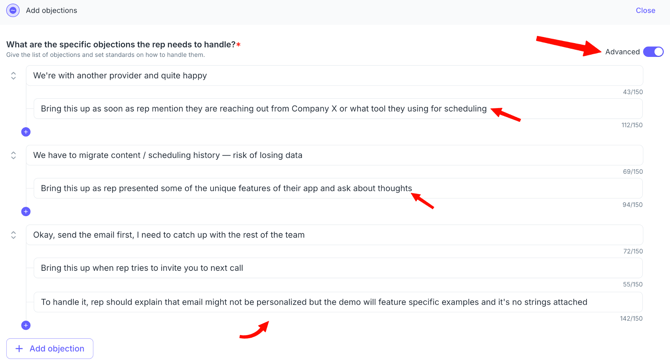
Objections do benefit from the Advanced mode. The recommendation is to add at least one condition per objection. There are three types of condition; here is when to use each.
- Trigger (always add this one). The time or action that brings the objection up: at what point in the call it appears, or what the rep does - or fails to do - that triggers it. You can frame it as an “only if”: if the rep misses this step, this is the outcome.
- Good / poor response example (optional). You can define what a good or bad response looks like
- Negative outcome (use sparingly). How the AI reacts if the rep handles the objection poorly. Good for cold calls and challenging sales calls. Do not add it by default - a third condition on every objection makes the role-play overly complicated.
How you phrase the example tells the AI what to match against:
- Exact phrase → verbatim matching. If you write a specific sentence, the AI looks for that exact wording. Use only when the precise phrasing truly matters.
- Framework → pattern matching. If you write a sequence of actions, the AI looks for the framework rather than the exact words. For example: empathize with the response, give an alternative solution, give a call to action. The rep can phrase it any way - the AI checks they hit the pattern.
When you write a condition, give the AI both the situation and the response, not just the response on its own. Use the handle / repshoot structure:
|
to handle it, rep should, <write the response or framework here> e.g. to handle it, the rep should empathize, give an alternative solution, give a call to action |